
Babycat may have been a “naturally occurring model of Alzheimer’s disease,” according to a new report in The European Journal of Neuroscience…
The Curious Genetics of Purring and Meowing
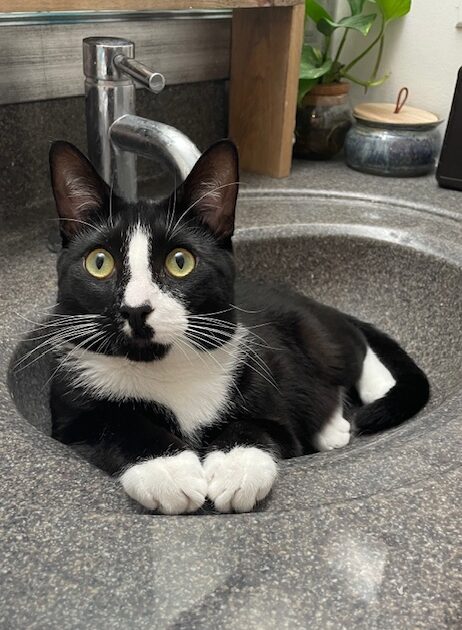
Far more attention is paid to dog behavior than to cat behavior. So I was struck by a recent report in Plos One from a trio of researchers at the Wildlife Research Center of Kyoto University that probes the “association between androgen receptor gene and behavioral traits in cats (Felis catus).” “Through our research, we hope to deepen our understanding of cats and contribute to building happier relationships between cats and humans,” said first author Yume Okamoto.
The paper is about purring and meowing, which I can attest are related and highly variable characteristics of cats.
Consider, for example, Archie Lewis. He commonly chatters and howls as he leaps about, ceasing only when a human, such as my daughter Carly, pays attention to him. Archie was in fact rehomed twice, before his current residence, because he wouldn’t shut up. Archie is now training an adopted sister, Josephine, so Carly is carefully observing any teaching moments that might be transpiring.
And as I wrote last week, our feline Babycat likely suffered from feline dementia, howling piteously at a corner of the ceiling in our bedroom.
Then there’s our youngest, Sydney, who seems incapable of making any sound whatsoever, but in seemingly complete silence, he emits a thrumming, persistent vibration that we think is his version of purring. He is apparently what Jerry Seinfeld called a low-talker – if you put your ear to his abdomen, there’s usually a rumble that isn’t digestive in nature.
The Androgen Receptor Gene on the X Chromosome
What do cat sounds actually mean? Since purring and plaintive meowing persist, the behaviors clearly offer some benefit, at least to the cat.
“Despite their popularity, few studies have investigated the genetic background of their behavior,” the researchers write. Many humans were quite willing to enroll their felines in their study. Ultimately, the team investigated 280 neutered/spayed mixed-breed kitties, 145 males and 135 females. Just run-of-the-mill cats – we cat owners are not as obsessed with lineage – no doodle this, doodle that – as dog owners. (See my take on the doodle obsession.)
“When we called for participants, we were moved to receive responses from 265 cat owners from across Japan in just a single day, and received kind messages. This reminded us of the strong public interest in cat research,” said Okamoto.
Androgens
Geneticists hypothesize which genes might be behind a particular trait based on what they already know, and the purring team turned to the androgen receptor gene. It is associated with aggression in many species. Testosterone is the predominant androgen, a type of steroid.
In humans, the androgen receptor gene is on the X chromosome, and because it is crucial to male sexual development (and hair and muscle growth), it and the protein it encodes has been well studied. Females have androgens too, which are important in bone density. The hormone molecules attach to receptors that festoon the surfaces of its target cells, then the combo moves into the nucleus, triggering the cascade of genes being turned on or off that produces the hormone’s effects, like beard growth and aggressive behavior.
But how does the androgen receptor affect meowing and purring?
(Gene) Size Matters
The cat owner participants in the study assessed 23 categories in the Feline Behavioral Assessment and Research Questionnaire, aka Fe-BARQ.
Genetically speaking, the researchers zeroed in on repeats of a particular segment of the androgen receptor gene that varies – the DNA repeat encodes the amino acid glutamine. They identified eight variants, each either “short” (≤18 repeats) or long (≥19 repeats), within the range of 15 to 22 repeats.
Cats carrying the short gene scored higher on the “purring” and “directed calls/vocalizations” scale. In contrast, females with short-type alleles showed higher “stranger-directed aggression” scores compared to females with long-type alleles. I don’t think the study accounted for feline teaching efforts – I’m sure Archie has been showing Josephine how to vocally manipulate Carly.
The study also discovered that the long 20-22 repeat androgen receptor gene is specific to cats.
Evolution
Geneticists like to reason “why” a trait may have evolved a certain way, based on how adaptive (helpful) it is in a specific environment. So the researchers propose that over feline evolutionary time, the long androgen receptor allele came to persist because domesticated felines no longer “need” the plaintive wail behavior attributed to the short allele. Their humans automatically provide food, shelter, and a place to pee and poop that magically gets cleaned up. When the humans travel, neighbors stop in to service the abandoned felines, or a contraption periodically plays the owner’s voice as a cup of dry food shoots out of a dispensary device. My daughter Sarah uses this strategy for her kitty Opal.
Interestingly, while short-type males yowled more toward their humans, female cats with the short-type gene “displayed higher stranger-directed aggression.” That might just mean that the females are smarter, doing something beyond bellowing.
The investigators also looked at the telltale androgen receptor gene segment among 11 other Felidae species. The leopard cat and the fishing cat, close relatives of run-of-the-mill pet cats, had only the short-type allele, compared to domestic cats. So the emergence of the longer gene variant, and its associated diminishing of vocalization, may have arisen from the genetic changes ushered in with domestication and selective breeding.
The researchers conclude that their finding “suggests that cats with a strong tendency to receive human care from birth may survive without vocal communication, leading to an increase in the frequency of the long alleles.” They also point out that the apparent decreasing importance of vocal communication, and the shift to the long-type gene variant, may have been propelled by purebred cats coddled from kittenhood. Plus, many of the mixed breed cats had been strays, which may imply that rescues tend to meow more.
Sometimes, common sense overrides genetic analysis. Just ask cat owners.