
My grandmother had what must have been Alzheimer’s disease, but no one ever called it that. When I visited her in the…
Dodos for Thanksgiving Dinner?
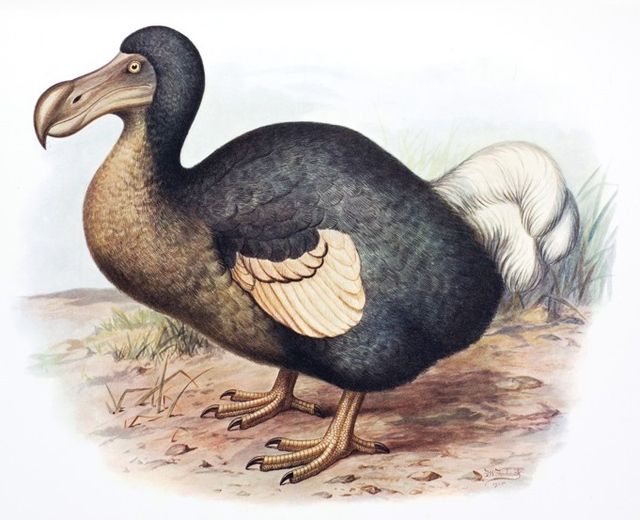
As Thanksgiving approaches, thoughts turn to turkeys. This year, the holiday comes soon after announcement of the first steps in recreating dodo birds – could we breed “de-extincted” dodos for Thanksgiving?
Do the math.
The extinct birds grow up to 50 pounds, and people consume about 1.5 pounds of turkey for Thanksgiving, less if side dishes are plentiful. So a single dodo could feed perhaps 35 or so people, accounting for the inedible parts. Both birds grow to about three feet tall, but a modern turkey, especially a wild one, is trim compared to a dodo, which is basically an overgrown pigeon. A Dutch sailor in 1662 supposedly described the soon-to-be extinct bird as a “kind of very big goose.”
Turkeys Reign on Martha’s Vineyard
I don’t eat turkeys, but I do appreciate them when I’m on Martha’s Vineyard, where they are more or less in charge.
If a bird ambles out onto a road and decides to squat for a time, cars stop.
If turkeys block a trail, hikers give them a wide berth. If the birds notice a human gawking, they may screech.
Sometimes turkeys alight on lower branches of a tree and poop, creating a linear turd line of sorts that is sometimes in size order.
The largest rafter – aka flock – of Vineyard turkeys I’ve encountered on a morning walk was 42. I was alone, and didn’t get too close. They typically ignore me.
The Vineyard turkeys are wild, with gloriously colored plumage. In contrast, a farm near my home in New York raises turkeys for Thanksgiving. The birds are huge, white, and sadly oblivious to their fate, even though a gigantic sign right near them on a main road advertises their availability for the upcoming human holiday. I’m glad that birds can’t read.
With two companies attempting to resurrect some sort of bird from bits of the dodo’s genome sequence, can a Thanksgiving substitute be far off?
Conservation or Conjuring the Past? Both.
Two organizations are pursuing bringing back the dodo, or parts of its genome stitched into that of a pigeon.
Non-profit Revive and Restore describes its goals in terms of conservation biology: “Our mission is to revive biodiversity and restore ecosystems through the genetic rescue of endangered and extinct species.” The dodo discussion has been ongoing for a decade, but obviously, we don’t have dodos back yet.
At Colossal Biosciences, a biotech company partnered with several academic and conservation groups, researchers use CRISPR to introduce genes from an extinct species into the genome of a modern relative, selecting traits that provide an intriguing or useful phenotype – like a cute white puppy pitched as a resurrected dire wolf because it began with a handful of ancient wolf genes. Or perhaps a zoo curiosity like a glyptodont (giant armadillo) or saber-toothed tiger.
Of course tweaking or replacing a few genes, out of the thousands in a genome, doesn’t recreate an extinct beast, or plant, like extinct flowers. The dramatic “de-extinction” preys on general unfamiliarity with genes and genomes.
Intriguing Science Behind the Hype
Bringing back part of the dodo genome uses a different approach from what Colossal did to conjure the so-called de-extincted dire wolf pups. Instead, researchers culture primordial germ cells, or PGCs, from the dodo’s closest living relative, a Nicobar pigeon (named for islands off the coast of India).
When PGCs divide, they give rise to eggs and sperm, the starting materials for a new individual. And so the PGCs provide a blank slate of sorts upon which to edit in genes of interest. The derived eggs and sperm, selected genes edited in, are maintained in chickens.
Actual birds do come into the picture. Company scientists select the phenotype – traits- by consulting CT scans of the skulls of many types of birds, choosing beaks and faces reminiscent of the dodo. It sounds a little like a patient choosing a nose at a plastic surgery practice.
Resurrecting a dodo using germ cells is necessary because an avian species can’t be cloned from a preserved cell, like Dolly the sheep. The germ cell approach enables researchers to pick and choose traits.
Hype in Overdrive
The company’s pitch that it’s “bringing back” or “de-extincting” the dodo is somewhat overstated.
“We have gene-edited birds!”
“In this mind-blowing update, we unpack the science shaking up the world of genetics. Colossal’s team shares the latest breakthroughs pushing dodo de-extinction from theory to reality, revealing how new discoveries continue to rewrite the story of extinction.”
“These discoveries form the genetic blueprint for the dodo’s return, and they’re only the beginning. For the first time, we can make genetic edits in birds and turn those edits into a living, breathing animal. The comeback of the dodo isn’t just possible, it’s happening.”
Something seems to have been lost between what the researchers have actually accomplished, and the easily-digestible idea that they’ve magically recreated an extinct animal.
Consider the numbers.
A pigeon genome is 1.2 billion DNA bases; the dodo genome is in the same ballpark, but only pieces of sequences have been identified. So conjuring up a 50-pound bird that is a dodo replica in a giant flask seems a way off …
If one reads beyond the hype, the scientists do acknowledge the challenge.
“The goal isn’t to create something that’s 100% identical to the species that used to be here. If we brought something back that was 100% identical, it wouldn’t necessarily fit in the environment of today. We have to think about the welfare of these animals—what is the rationale for doing this in the first place? This is not just a stunt to see if we can create something that’s 100% identical. That’s not the point anyway,” explained Beth Shapiro, Chief Scientific Officer and world expert on ancient avian DNA, in a GEN Biotechnology report, Ancient DNA and the De-Extinction Debate.
The website apparently cherry picks quotes in a way that contradicts what the scientists are actually saying. According to Dr. Shapiro, in contrast to the above comment, “There has never been more urgency to preserve species than there is today. It’s not just important for their continued existence. It’s for the greater good of the planet. Together, Colossal and the scientific community at large are committed to our efforts to de-extinct those we’ve lost.”
A Dodo Description
The dodo thrived on the island of Mauritius, 1,200 miles off the southeast coast of Africa in the Indian Ocean. In 1598, rough seas forced the Dutch ashore. They brought black rats, goats, macaques, pigs, and deer, which ate the giant, slow-moving birds and their eggs. Soon the enchanting, flightless birds, which according to historical documents were friendly to the newcomers, were gone – reportedly by 1690.
Suffolk University in Boston’s Eugenia Gold, a dinosaur paleontologist who is expert in pigeon brains, described dodos in this news release from 2016:
“When the island was discovered in the late 1500s, the dodos living there had no fear of humans and they were herded onto boats and used as fresh meat for sailors. Because of that behavior and invasive species that were introduced to the island, they disappeared in less than 100 years after humans arrived. Today, they are almost exclusively known for becoming extinct, and I think that’s why we’ve given them this reputation of being dumb.”
By 1690, they were gone.
Not Dumb, But Adapted to Their Environment
Dodos likely weren’t, well, dodo-brained. That popular depiction may be a human spin on the traits that natural selection molded. Consider:
• The birds were monogamous, and laid only one egg a year, exposed in low-lying areas. But there were no predators, so a lone egg could survive.
• Dodos didn’t fly, or lost the ability to do so, because this skill wasn’t essential to their survival. There was nothing to fly away from – why bother?
• They ate pebbles. They likely learned that from elders because rocks in the gut aids digestion, a little like a human guzzling Metamucil. In scientific lingo, their gizzards held gastroliths – bits of rock – which enabled them to digest nuts and seeds.
• Their knees bulged because their musculature helped them walk on the rocky terrain – a little like mine from hiking.
• The birds were large, because food was plentiful and predators non-existent.
• Their wings were small. Large wings conferred no survival advantage.
Over the eons, natural selection led to bigger bodies and smaller wings for the three-foot-tall birds.
Human observers likely embellished the look of the bulbous birds with inferring a friendly personality. Dr. Shapiro calls them silly-looking, and they certainly seemed so in Alice in Wonderland.
Dr. Shapiro’s research finds that the ratio of the dodo’s size to its brain capacity isn’t much different from that of a pigeon, a notoriously intelligent bird. And the dodo brain had a huge olfactory bulb compared to other birds, indicating a powerful sense of smell that might have helped them locate food in their ground habitats.
CODA
Of course I’m not serious about bringing back dodos just to eat them. But the idea did make me look into how Thanksgiving turkeys are raised, and it isn’t pretty.
Turkeys bred for Thanksgiving tables arise from artificial insemination, because the birds are too big to have sex. Presumably restored dodos could have sex.
Thanksgiving turkeys can’t fly, but not because they don’t need to. It’s because they’ve been “bred” to have huge breasts and legs, so they can’t get off the ground. I recall with disgust once eating a humongous, dripping turkey leg at Disney World.
Domestic turkeys are harvested as early as 12 weeks and up to 16 weeks and weigh between 20 and 35 pounds, before they’re stuffed. Wild turkeys at that age are barely 5 pounds, according to the National Wild Turkey Federation. And the domestic kind are so highly inbred that they’re susceptible to infection, so their drinking water is laced with antibiotics.
In the US, we kill 270 million turkeys each year.
If a human baby grew at the same rate as a modern farmed turkey, it would weigh 1,500 pounds by the age of 18 weeks. Farmed Animal Welfare: Turkeys, from the Massachusetts Society for the Prevention of Cruelty, features gruesome descriptions of what turkeys endure before they end up on a Thanksgiving platter.
Finally, there’s simply no need to eat a turkey! I’m getting a token Sam’s Club chicken for my carnivore guests, but making many veggie-based “sides.” A meatless Thanksgiving is not only possible, but better.