
My grandmother had what must have been Alzheimer’s disease, but no one ever called it that. When I visited her in the…
Memories of Craig Venter
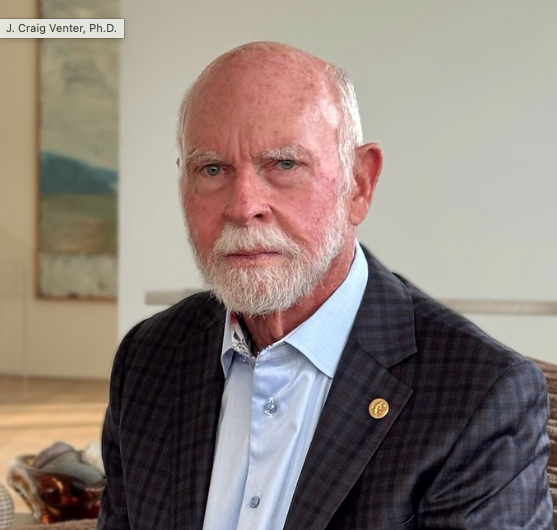 J. Craig Venter (credit Brett Shipe, JCVI)
 I was saddened to hear of Craig Venter’s passing at the age of 79, today, April 30, 2026. Often portrayed as the bad guy, sometimes to Francis Collin’s good guy, my handful of interactions with the man were positive and memorable. He was a genius, inventing technologies through a string of institutes and businesses that earned him the label of a “serial entrepreneur.”
A True Genius
Dr. Venter is best known to the public as the “other” researcher “racing” to complete the first, in retrospect quite spotty, human genome sequence. The official announcement came on June 26, 2000, in the White House Rose garden (now desecrated with stone and yellow umbrellas), Venter and Francis Collins outwardly convivial after a sometimes bitter, headline-inspiring race.
But I needed to know who’d gotten to the finish line first – Venter’s Celera Genomics or the National Human Genome Research Institute in March, because I was working on the new edition of my human genetics textbook and wanted to include that information. My deadline was looming.
I’d recently met Venter to interview him for an article in The Scientist, so I e-mailed him. No, he answered immediately, he wouldn’t update me directly, but if I emailed him a multiple choice question, something to the effect of who got there first, Celera, NHGRI, both or neither, he’d answer, but I couldn’t publish that info. He answered that indeed, it was he. I was able to get the shared announcement in June into my textbook before another semester rolled around.
Dr. Venter invited me back to interview for a remote job, helping to assemble a compendium of intriguing human genes, chromosome-by-chromosome. When I walked down the long hallway to his expansive office, I felt like Dorothy approaching the great Wizard of Oz. But my nervousness vanished instantly, as we fell into conversation and excitement about all the gene discoveries, quickly finishing each other’s sentences. And I helped, briefly, with the project.
Next I saw him at an international genetics conference in Sweden, 3 weeks after 9/11, a scary time to fly. He was in tears as he opened the meeting.
Venter’s Inventions
Craig Venter notoriously saw what others didn’t.
His invention of “shotgun sequencing” quickly overshadowed the slower “clone-by-clone” technique of the government effort. His approach blasted several copies of a genome into smithereens and rebuilt the overall sequences by overlapping the pieces. Meanwhile, the NHGRI approach proceeded by inching across whole chromosomes. (“Clone” refers to a piece of DNA.)
Another famous Venter invention is expressed sequence tags, aka ESTs.
When everyone was yammering on about “racing” to decipher “the” human genome sequence, never mind that we all have millions of distinctions, Venter was focusing on the 200-to-500 DNA base ESTs. These bits of DNA were created (“reverse transcribed”) from mRNA molecules, and dubbed cDNAs (c stands for complementary). The collection of transient mRNAs in a particular cell under particular conditions, represented as the more stable cDNAs, provides a glimpse of gene expression in that tissue and time.
The invention of ESTs perhaps presaged the mRNA vaccines that today target viral diseases and cancer. But at the time, James Watson dismissed ESTs as “bits of junk” that would actually slow the sequencing effort, and objected to Venter’s patent.
Sequencing Genomes
His interests extended well beyond human health. He pioneered metagenomics, the strategy of sampling all of the DNA in an environment and deducing the resident organisms. He described deep sea life forms from their shed genetic material, constituting the marine microbiome.
And who else but Craig Venter would attempt to invent life, from basic chemicals up? His Synthetic Genomics effort became Viridos, which filed for bankruptcy last year.
He introduced the first “hypothetical minimal genome” in 2010, whittling it down from the natural genome of tiny microbe Mycoplasma genitalium. Its half-a-million or so DNA bases encode a mere 473 genes. Venter named it JCVI-syn3.0, JCVI for the J. Craig Venter Institute. Beat that, Donald!
Venter monetized personal genome sequencing, at first charging $25,000 and pitching the data as a life extension tool. To that end, in 2014 he founded Human Longevity Inc. “to advance precision, pre‑symptomatic medicine.” At the time, the idea to combine genome sequencing with all manner of tests and scans to predict an individual’s lifespan was indeed novel. The effort amasses genome sequences and tons of clinical data, from people of all backgrounds, ages, experiences, and health status.
After some legal tussles and changes in leadership, including a dismissed lawsuit against Venter, the company still exists, in San Diego and South San Francisco. And of course now the idea of combining genome sequencing with scans and many other testing modalities is everywhere, for those who can afford it of course.
Most recently, Venter founded Diploid Genomics (DGI) in January 2026. The company’s strategy is to combine complete sequencing of each chromosome (including the repeats and other parts that do not encode protein) in a diploid cell, to assess the contributions of both parents, with clinical data and imaging, to derive “an AI-driven unified patient profile, transforming how early stage disease is predicted, detected, and treated.”
CODA
It is sadly ironic that Venter’s final focus, as far as I know, was extending the human life span, through Human Longevity Inc.
But even the most sophisticated, data-drenched predictive models can’t foretell all – getting hit by a truck, struck by lightning, attacked by an ICE agent, or sent to war.
Ironically, all those data can’t predict the somatic mutations that happen in our non-sex cells all the time, as natural errors of the imperfect process of DNA replication. Nature makes mistakes. And that’s how one errant cell, with an activated oncogene or dampened tumor suppressor gene, divides to produce another, and they divide, and on and on until a tumor grows.
We can’t predict who will die from what, and when. I’ve had cancer twice, and I’m so sorry that the unforgettable Craig Venter died at age 79 from a cancer treatment. But I’m so glad that I met him, even just briefly.
Said Anders Dale, president of JCVI, “Craig believed that science moves forward when people are willing to think differently, move decisively, and build what doesn’t yet exist. His leadership and vision reshaped genomics and helped ignite synthetic biology. We will honor his legacy by continuing the mission he built—advancing genomic science, championing the public investments that make discovery possible, and partnering broadly to turn knowledge into impact.”
(photo credit Brett Shipe, JCVI.org)