
My grandmother had what must have been Alzheimer’s disease, but no one ever called it that. When I visited her in the…
The Last Carolina Girl, a Novel, Echoes the Famous Case of Carrie Buck and the Eugenics Movement
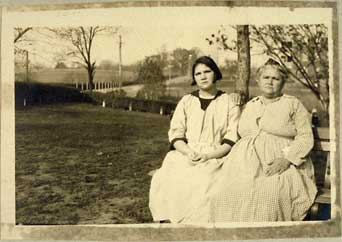 Carrie Buck and her daughter Emma, neither of whom was likely "feebleminded."
 In early spring, when I pull out the puniest of garden plants and toss them aside to make room for the more robust, my thoughts turn to eugenics.
I recently discovered a compelling work of historical fiction, Meagan Church’s 2023 The Last Carolina Girl, which captures the horror of the movement in the first half of the twentieth century in the US to force eugenic measures on women.
Church is a master of describing the abuses against women that were once ignored and accepted. She wrote 2025’s The Mad Wife, which looks at a tranquilized housewife in the 1950s, and 2024’sThe Girls We Sent Away, about the fate of an unwed pregnant teen in the 1960s.
The Last Carolina Girl is set in 1935 North Carolina. When 14-year-old Leah Payne is orphaned, kind neighbors, who cannot afford to raise her, send her to a family willing to take her in – but, as Leah soon discovers, not as a foster child, but as an abused “helpmate.” The tale is loosely based on the author’s great aunt.
Comparisons to Delia Owens’ Where the Crawdads Sing, published in 2018 and a film four years later, led me toThe Last Carolina Girl, also about a nature-loving, adventurous North Carolina girl. But it is much more.
The eugenics theme at the core of the plot emerges subtly in the middle of the tale, then hits with staggering force when Leah is tricked into being sterilized. The reason – her blackout “spells” – seizures likely stemming from fever in early childhood, not an errant gene that could be passed on.
When the narrative turns to eugenics, Leah’s story begins to echo the tale of Carrie Buck.
A Famous Case
In 1927, 17-year-old Carrie Buck was tried as a criminal in her hometown of Charlottesville because her mother lived in an asylum for the “feebleminded” and Carrie had given birth out-of-wedlock, despite having been raped by her foster parents’ nephew. She was blamed for the forced pregnancy, deemed “promiscuous.”
Carrie was declared feebleminded too, although she was a B student in school. Sir Oliver Wendell Holmes Jr., in Buck v Belle (1927), famously ruled “three generations of imbeciles are enough” in approving her forced sterilization.
Carrie Buck joined her mother Emma at the Virginia State Colony for Epileptics and Feeble-Minded in Madison Heights, near Lynchburg, and became the first person sterilized to prevent having another “socially inadequate offspring.” A crude pedigree drawn at the time depicted Carrie Buck and her “inherited trait” of feeblemindedness.
According to the DNA Learning Center, Carrie Buck’s trial was an intentional test case for the state’s 1924 sterilization law, and her lawyer was in on it. After Carrie was released, she went on to a life of apparent mental normalcy, as did her supposedly feebleminded daughter Vivian, whose teachers reported her intelligence as above-average.
The Supreme Court’s decision in Buck v Bell led to an estimated 65,000 to 70,000 forced sterilizations.
A Horrific Tale Unfolds Slowly
The Last Carolina Girl’s plotline revolves around the fact that the mean woman who takes Leah in as a helpmate is actually her aunt, who harbors a long-simmering revenge agenda.
The eugenics theme emerges halfway through the narrative, when protagonist Leah and her friend Jesse are at a country fair, Leah sneaking away for a bit from her evil guardian. Leah and Jesse are riveted by a man addressing the crowd with posters depicting black and white rats, illustrating “genetic Inheritance.”
“Dr. Foster addressed the crowd:
When you take a pure white and a pure white, what are the results? Pure white, of course. No tainted abnormalities. But mix in a black with a pure white, and you’re not guaranteed what you’ll get. Any impure abnormality can result.
How many generations of abnormalities is too many?” the doc continued, echoing Oliver Wendell Holmes.
He went on, “Especially when we have the ability to do something about it? To stop it. To sterilize the offender—the feebleminded, the promiscuous—so future generations don’t have to suffer. Sterilization is a simple procedure that will ensure that those people won’t have future generations who will drain our society.” The mesmerized crowd nodded in agreement.
The Examination
Later on, Leah’s mistress, Mrs. Griffin, forces her to see the doctor from the fair. He conducts a terrifying pelvic exam, and then seeks to demonstrate the three strikes against her: seizures, promiscuity, and subnormal intelligence.
Paramount are the seizures.
“He asked me about my flashes, though he called them my absences. I wondered how he knew. Of course Mrs. Griffin had to’ve told him. I knew she’d spotted a couple in my months with them, but apparently she’d seen more than I’d realized,” Leah thinks.
The doctor steps back, addressing Mrs. Griffin. “From my examination of her, there’s clearly something wrong. Not having seen one of her episodes for myself, I have to take your word for them, but I’m inclined to say she’s suffering from absence seizures.”
Next came demonstration of promiscuity. “Just the other day at the fair, I caught her behind a tent with a boy who isn’t from around here. I can’t even imagine what would’ve happened had I not found them then,” Mrs. Griffin told the doctor.
Finally, when Leah appeared puzzled at being handed a book meant for a young child, the doc assumed she couldn’t read. “It’s clear that she is not as mentally astute as others her age,” he concluded. “Thankfully we do have a procedure to help with this sort of situation.”
After the procedure, Leah eventually realizes what has happened:
“I was one of those rats hanging on the poster board. I was one of the tainted ones, the burden needing fixing.”
The repercussions of the assumption that Leah was not mentally fit echo throughout what would be a very long life.
In The Last Carolina Girl, Meagan Church has vividly knitted a compelling story around a time tainted with profound prejudice and cruelty, superimposed on the subjugation of women.