
My grandmother had what must have been Alzheimer’s disease, but no one ever called it that. When I visited her in the…
New Study Suggests Why the Mediterranean Diet is so Healthy – and a Recipe
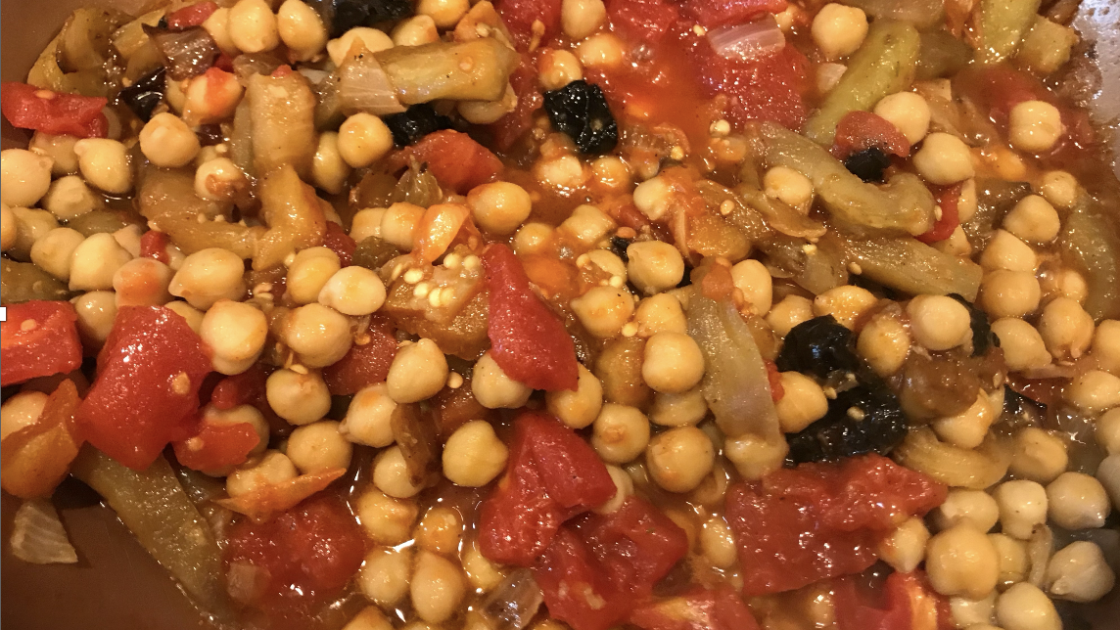
A Mediterranean diet emphasizes fruits, vegetables, whole grains, legumes, seeds, nuts, and especially olive oil, with a few heart-healthy cheese choices – mozzarella, ricotta, and especially feta – and some lean poultry and fish. It has long been associated with lower risk of diabetes, heart disease, and cognitive decline, but how it does so has been mostly a mystery. I’ve followed this way of eating for years – this post ends with an easy recipe for a vegetarian Moroccan stew.
A new report in Frontiers in Nutrition suggests the source of the benefits of the Mediterranean diet at the molecular level: two tiny proteins made in the mitochondria, the tiny, footprint-shaped organelles that house the biochemical reactions that extract energy from nutrient molecules.
Mighty Mitochondria
In middle school biology classes, the mitochondrion is dubbed “the powerhouse of the cell” for good reason. Festooned along the intricate infoldings of the organelle, the energy “currency,” the molecule ATP (adenosine triphosphate), runs the cell using the energy captured in its chemical bonds.
A cell may have a few hundred to tens of thousands of mitochondria, depending on activity level. A rather sedentary liver cell has about 1,700 mitochondria, but a highly active skeletal muscle cell may have 10,000 or more.
Mitochondria don’t just sit there. They move about within a cell and can transport DNA from one cell to another, a recent discovery. They coalesce and break apart, like bubbles in a bathtub, assuming different volumes.
Most intriguing is that mitochondria have their own genome, consisting of 37 genes. They reproduce, release heat, and send and receive molecular signals.
These eclectic organelles have a bad reputation when they cause mitochondrial diseases, which typically cause great fatigue and other symptoms. But they also hold a special place in the history of biology as the basis of the endosymbiont theory. This is the idea that mitochondria were once free-living microorganisms that were captured by larger single-celled microorganisms, contributing to the evolution of our own more complex, eukaryotic cells.
More practically speaking, the hardier and smaller mitochondrial DNA is more likely to survive the harsh conditions of disaster than DNA from a cell’s nucleus, and so they serve as a forensic tool. (See Maui Fires: How Mitochondrial DNA Will Identify Human Remains.)
Two Tiny Proteins
In the new study, Roberto Vicinanza, a gerontologist at USC and colleagues identified two tiny proteins from mitochondria, called humanin and SHMOOSE (an acronym far more exciting than what it stands for), that may be intimately involved in how age-related diseases arise – and how some people manage to avoid them.
The microproteins are so small, under 100 amino acids long, that their genes were too tiny to have been picked up in human genome sequencing efforts. The new study found that adherents to a Mediterranean diet have higher levels of the microproteins, both of which have been linked to protection against neurodegenerative and cardiovascular disease.
“These microproteins may act as molecular messengers that translate what we eat into how our cells function and age. It’s a new biological pathway that helps explain why the Mediterranean diet is so powerful,” Vicinanza said.
That might be a bit of an overstatement.
A Preliminary Investigation
The study looked at markers of oxidative stress, a key driver of aging and chronic disease, in only 49 patients, average age 78, recruited from an observational study of atrial fibrillation. The participants took the “9-item Med-Diet questionnaire,” which provides a score, from 0 (low) to 18 (high), based on how frequently people reported having eaten foods from nine categories: fruit, vegetables, meat, cereals, dairy, alcohol, olive oil, legumes, and fish.
Twenty patients reported following a Mediterranean diet. The folks who ate more olive oil, fish and legumes had higher levels of SHMOOSE and humanin in their blood, while those who didn’t had higher markers of oxidative stress. Specific correlations suggested that olive oil is the healthiest component of the diet, legumes came in second, and refined bread the worst, according to the oxidative stress markers.
“These findings suggest that specific components of the Mediterranean diet may directly influence mitochondrial biology. Humanin and SHMOOSE could serve as biomarkers for adherence to the Mediterranean diet and have clinical significance,” said senior author Pinchas Cohen. He discovered humanin in 2003, which has been linked to improved insulin sensitivity, cardiovascular protection, preservation of cognitive function, and longevity. SHMOOSE was more recently discovered and is linked to brain health. A variant of the gene is associated with increased Alzheimer’s disease risk and the normal variant may protect brain neurons from amyloid-induced damage.
“These peptides are emerging as key regulators of aging biology,” Cohen said. “They connect mitochondrial function to diseases like Alzheimer’s and heart disease and now, potentially, to nutrition.” And so the Mediterranean diet may work two ways: lowering oxidative stress while boosting levels of mitochondrial microproteins that further dampen damage.
Vicinanza put the work into perspective. “We’re connecting centuries-old dietary traditions with cutting-edge molecular biology. It supports the idea that healthy eating patterns with little to no ultra-processed foods reflect how humans have eaten over long periods and may create conditions to which mitochondria—ancient cellular organelles—are likely adapted.”
The researchers envision the two tiny proteins as biomarkers that could help people tailor their diets to optimize brain health and longevity. “Our goal is to move from observing associations to understanding causality,” Vicinanza said. “If we can harness these pathways, we may be able to design nutritional strategies that promote healthy aging at the molecular level.” But don’t we already know this?
A Culinary Coda
I love the idea of finding biological reasons for an observation, like a diet linked to improved heart or brain health. But an observational study of a few dozen people, who report what they’ve eaten, isn’t very powerful.
Instead, it’s easier to just eat foods that include those of a Mediterranean diet. Here’s one of my faves.
Moroccan Chickpea + Eggplant Stew
Ingredients (2 big servings)
Half a large eggplant or a small one, cut into strips
Half an onion, chopped (or more)
3 cloves garlic, shredded
1 can chickpeas
1 can tomatoes
dried fruit (handful): prunes, apricots, dates, cranberries, yellow raisins
dried Mediterranean (Moroccan) spice mix
Sautee eggplant strips, onion, and garlic with salt + pepper. Add most or all of the tomatoes, chickpeas, and dried fruit. Add 1 teaspoon dried spices
Cook for awhile and eat, or put in crockpot for a few hours.
Enjoy!